The Unseen Forces Shaping Senegal’s Financial Crisis
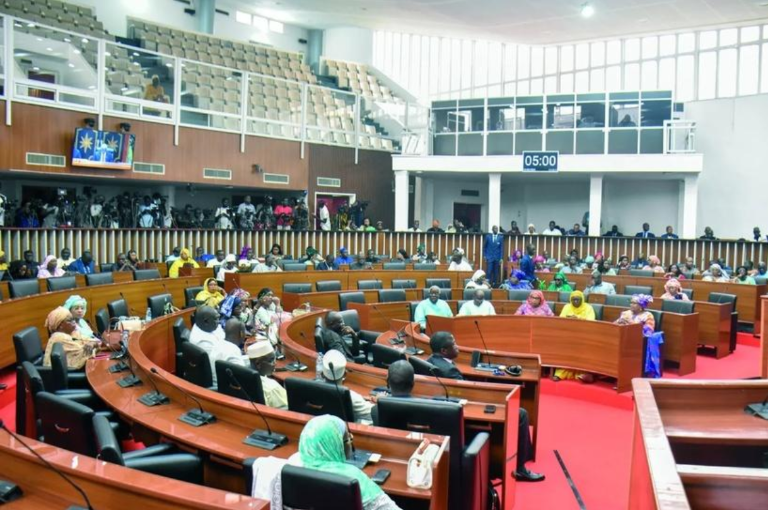
The November 3 vote wasn’t just another legislative setback—it was a rebellion brewing within the ruling party itself. With 109 votes against, 20 in favor, and 3 abstentions, Senegalese lawmakers approved a preliminary motion tabled by the Pastef party, effectively killing any further debate on the 2026 supplementary budget law. This wasn’t the first time the proposal had been rejected; it had already failed twice in the finance committee back in October. In a parliament where the ruling party holds 130 of the 165 seats, the internal machinery of political obstruction is overshadowing traditional majority-opposition dynamics, revealing deeper structural tensions at play.
Why Dakar’s Signature on International Agreements Now Hangs in the Balance
As early as October 19, the president of the National Assembly and Pastef leader Ousmane Sonko made it clear: no passage of the 2026 supplementary budget or the 2027 initial finance bill would occur without prior legal oversight of special funds. This procedural blockade, compounded by disagreements over how best to target aid for vulnerable households, has deprived the government of the critical fiscal tool needed to adjust revised public data. That adjustment is precisely what the International Monetary Fund (IMF) is waiting for before submitting the technical agreement—signed on September 1— to its executive board. The deal, worth $2.2 billion over 36 months, could be at risk if Dakar fails to meet these conditions in time.
The Minister of Economy, Abdourahmane Sarr, has publicly urged compromise, even acknowledging that dissolving parliament might become the only remaining option if no middle ground can be found. Meanwhile, President Bassirou Diomaye Faye, questioned during a United Nations General Assembly session in September, refused to rule out any scenario. The silence from private creditors holding Senegal’s eurobonds is equally telling. With several rating agencies already downgrading Senegal’s sovereign debt to speculative grade since 2024, the stakes are higher than ever—and the IMF isn’t the only gatekeeper in this high-stakes game.
The Constitutional Deadline of December 2 and the March 2027 Wall
Come December 2, 2026—exactly two years after the legislature was sworn in—President Faye will regain the constitutional power to dissolve parliament. A precedent from 2024 offers a clear timeline: the dissolution decree was signed on September 12, the election held on November 17, and the new assembly seated on December 2—a roughly 80-day cycle. If applied to a potential dissolution this December, the election would likely fall on a Sunday in February 2027, within the constitutionally mandated 60-to-90-day window. In the interim, the president would govern by decree, and the 2027 budget would be extended through the same mechanism by January 1.
Such a scenario carries significant costs. By March 13, 2027, Senegal must make a €400 million payment on its 2028 eurobond obligation, including one-third of the principal and two coupons. Without the IMF’s initial disbursement, accessing international markets would become prohibitively expensive. The alternative—a restructuring under the G20’s Common Framework—would introduce delays reminiscent of Zambia’s experience, which began negotiations in 2021 and has yet to secure substantial relief, or Ghana’s default in December 2022, whose eurobond restructuring wasn’t finalized until late 2024.
Three Possible Paths, One Decisive Arbitrator
Scenario one: a compromise is reached, with the supplementary budget amended before December 2, the 2027 finance bill passed by December 31, and IMF board approval secured between December and January. This would unlock the first tranche of funding and pave the way for formal talks with eurobond holders.
Scenario two: parliament is dissolved, shifting the decision to the ballot box but creating a two-to-three-month governance gap governed solely by decrees. Public finances would be paralyzed during this period, and the March 2027 debt deadline would loom large.
A third, hybrid option could involve passing a minimalist bill focused exclusively on the oversight of special funds—enough to satisfy Sonko’s procedural objection without triggering a full-scale budget debate before December 2.
Across all three scenarios, the final arbiter remains the same: the bond markets. Every political milestone will be judged by how much risk premium investors demand to continue financing Senegal. The country’s future is now being written at the crossroads of its constitution, its IMF memorandum, and the fine print of a nearly decade-old sovereign bond prospectus.